
Carotid Artery Disease
Carotid Artery Disease Treatment
Most people with carotid artery disease do not know it. There is no discomfort, no warning signal. The arteries on both sides of the neck narrow quietly for years, and often the first sign is a stroke, or a brief episode where speech became difficult, vision blurred, or one side of the body went weak before things returned to normal. Richmond Heart and Vascular Associates evaluates and treats carotid artery disease for patients throughout Central Virginia, with the goal of finding the problem while there is still time to act.
What Is Happening in Your Neck
Two carotid arteries, one on each side of your neck, carry oxygen-rich blood to the brain. Over time, plaque, fatty deposits along the inner artery wall, can narrow those vessels and restrict blood flow. This process, called atherosclerosis, develops slowly and silently.
The risk arrives when a piece of plaque breaks free or a clot forms at a narrowed spot. Either can reach the brain in seconds and cause a stroke.
Risk Factors
Warning Signs That Require Immediate Action
A transient ischemic attack, or TIA, is a brief interruption of blood flow to the brain. Symptoms look like a stroke but clear within minutes to hours. A TIA that resolves is still an emergency and a direct warning that a more serious stroke may follow.
Any of these signs should prompt a call to 911 right away:
Face Drooping or Numbness
Sudden drooping or numbness on one side of the face
Leg Weakness or Numbness
Weakness or numbness in one arm or leg
Sudden Speech Issues
Sudden trouble speaking, finding words, or understanding speech
Vision Issues
Vision that blurs, doubles, or goes dark in one eye without warning
Headache
A sudden severe headache with no clear cause
Risk
What Raises the Risk
Carotid artery disease develops faster when certain conditions are present including:
High Blood Pressure
High blood pressure damages artery walls over time, making plaque formation more likely.
High Cholesterol
High cholesterol provides the raw material for that buildup.
Diabetes
Diabetes accelerates artery damage.
Smoking
Smoking directly injures the vessel lining and sharply increases plaque formation.
Family History
A family history of stroke or atherosclerosis suggests a genetic tendency worth discussing with your physician.
Diagnosis
How We Evaluate the Arteries
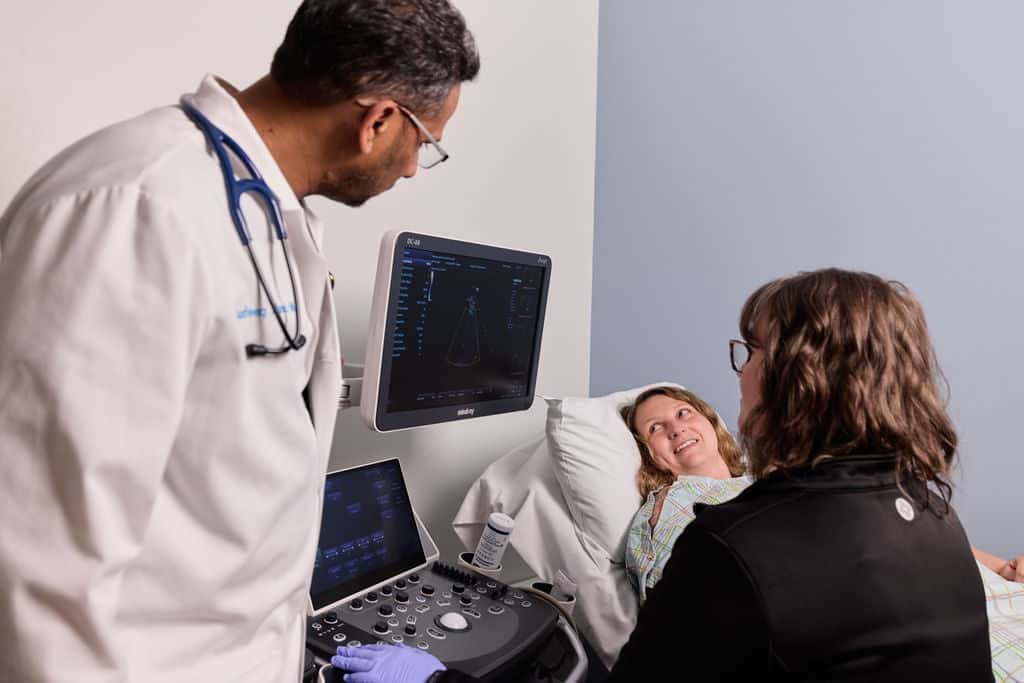
Carotid ultrasound is a first step for evaluating the carotid arteries. It uses sound waves to image the artery walls and measure blood flow through them, with no radiation, no discomfort, and no invasive steps. Your physician gets a clear answer about whether narrowing is present, where it is, and how severe it has become.
If significant narrowing is found, your physician will review the results and discuss next steps.
How We Address It
Treatment is based on the degree of narrowing and your overall stroke risk. Your physician will explain what each option does and why it fits your specific situation.
Medical management
Antiplatelet medications such as aspirin make it harder for clots to form in a narrowed artery. Statins lower cholesterol and help stabilize plaque so it is less likely to break free. Blood pressure medications reduce the ongoing damage to artery walls. Together, these form the foundation of care for most patients.
Carotid endarterectomy
When narrowing has reached a level where stroke risk is high, a vascular surgeon can open the artery and physically remove the plaque from inside it.
Lifestyle changes
Quitting smoking is one of the most effective steps for slowing plaque progression. A heart-healthy diet, regular physical activity, and careful management of diabetes each reduce the risk factors for carotid artery narrowing.
Carotid artery stenting
For patients who are not good candidates for open surgery, a small mesh tube placed inside the artery can hold it open. Your physician will determine if you are a candidate.
Accredited testing
Accredited Services, Reliable Results
Echocardiography Accreditation
IAC-accredited echocardiography imaging for precise evaluation of heart structure and function.
Nuclear Cardiology Accreditation
IAC-accredited nuclear stress testing and myocardial perfusion imaging.
Vascular Imaging Accreditation
IAC-accredited vascular ultrasound lab for arterial and venous studies.
Richmond Heart and Vascular Associates holds accreditation in echocardiography, nuclear cardiology, and vascular imaging. These accreditations are awarded by independent national organizations and are based on ongoing reviews of image quality, clinical performance, and safety standards. Every test is interpreted by one of our own board-certified cardiologists, not an outside reading service.
Why our patients choose us
Why Choose Richmond Heart and Vascular Associates
If you have risk factors for stroke, have experienced a TIA, or have been referred for carotid imaging, do not wait. Schedule an appointment online or call Richmond Heart and Vascular Associates at 804.800.6600. Our office is open Monday through Friday, 8:00am to 5:00pm.
Over 30 years of cardiovascular and vascular care serving Central Virginia
Vascular-credentialed physicians, including board-certified cardiologists with RPVI designation
Carotid ultrasound and in-office diagnostic services for efficient, convenient evaluation
Coordinated care and referral management across Mechanicsville and Hopewell locations